


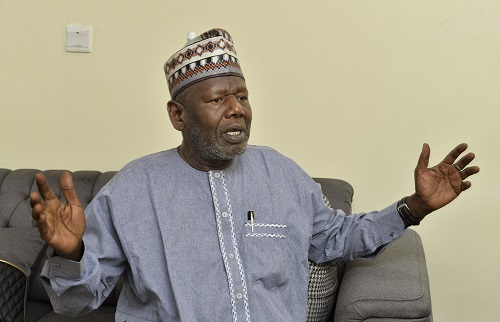
Professor Abba Gambo has graced the halls of the Nigeria Governors’ Forum as the Senior Agricultural Adviser. The Professor has always had a deep love for Agriculture as he says that agriculture entered his mind right from the palace.
‘‘My mother had a small garden within the palace so that maybe triggered me into Agriculture,’’ said the Professor.
In addition, his family history is rooted in Agriculture as a majority of his family members were all farmers. That is where he picked the agriculture trade.
From his academic days, he continued to develop himself in the field of Agriculture which garnered him great respect and a demand for his high expertise.
In this candid interview with the NGF media team, he elaborates on his education/background, career, and his new role at the Nigeria Governors’ Forum Secretariat in which he promises to deliver the very best agriculture desk that can be found anywhere.
Tell us a bit about your background: (Education & Career)?
From a young age, I knew that I wanted to study Botany. At Ahmadu Bello University in Zaria, I went to the Vice Chancellor’s office: Professor Ango Abdullahi, one of the most famous professors then, and told him that I want to study agriculture.
He took my details and said he would reach out to me but didn’t till matriculation. I later left Zaria and came back to Maiduguri.
My father then personally took me to the then Vice-Chancellor, M.N. Alkali. Due to my excellent grades, the Vice-Chancellor insisted that I should go for medical science. I declined and insisted on reading agriculture.
That was when I saw my father’s annoyance for the first time and of blessed memory, he said that he doesn’t understand what I want to become?
I told him that I want to be an Agriculturist so that I would manage his farm.
I was later admitted into Agriculture in the University of Maiduguri where I became the very first Horticultural Graduate. I then did my National Youth Service Corps (NYSC) at the deformed Gongola State before it was split into Gongola and Taraba.
After, I was posted to teach Agriculture at Federal Government Girls College, Yola.
When I completed my NYSC, I came back to Maiduguri where I was given an automatic appointment at my university as a Graduate Assistant. This was based on my academic performance.
Two weeks after, I got admission into the University of Ibadan for my Masters, MSC in Agronomy. I passed out with flying colors, and they gave me an automatic admission for Ph.D. immediately, also based on merit.
However, when I came back to the University of Maiduguri, my Horticultural lecturer was sent to the U.S. on scholarship by the university, but he disappeared.
As a result, the university asked me to stay and take up his role since I was also a Horticultural graduate.
After that, I was admitted to Usmanu Danfodiyo University Sokoto for my Ph.D. where I finished my degree in record time. It took me only three years.
In addition, while doing the Ph.D., they also appointed me a post as the Visiting Lecturer.
You left NGF for a purpose, please share with us?
In the beginning, I came as a Senior Lecturer with my Ph.D. and for me to get my professorship, I had to be on the ground. I wanted to leave but NGF didn’t want me to leave.
I told the DG that do you want a situation where my juniors would be my seniors? The DG then told me in plain language that I am irreplaceable. When the DG told me that, I was humbled and honored.
Also, that word comes with a lot of responsibility, especially with agriculture at the front burner in not just Nigeria but globally, in Russia and Ukraine with the wheat crises.
Being told that I am irreplaceable means that I have more responsibilities and the demand for achievement is higher on me now than when I started.
What do you bring to the table that is different from the past?
First, I want to commend the management and staff for being here at the beginning. We started with a small office, and it has now expanded and there are meeting rooms where Governors can come and discuss.
Secondly, I come at a time when there is a global food crisis. The Russian and Ukraine war is affecting the production of wheat. These two countries produce 50% of the global wheat in the world.
Because of the war, that 50% is lost. Now, 45 countries are dependent such as Saudi Arabia, United Arab Emirates, Egypt, Burkina Faso, and Nigeria.
Out of the 45, 18 are developing nations. Now, due to the war, the farmers are all on the battlefield. There is also a sanction on Russian products.
Then, the second alternative is India that is producing plenty of wheat.
Then, countries turn to India, and suddenly, India says they are not exporting one grain of wheat until December of 2022. So, the price of bread in Abuja you initially bought from N150 to N200 is now selling for N900.
Now, what I want to do is bring a solution to the wheat crisis in Nigeria. We have identified the areas in Nigeria that produce wheat. We want to do a national roundtable on wheat as quickly as possible in conjunction with agencies such as the Federal Ministry of Agriculture, the Central bank of Nigeria, and all the states and commissioners so that we fill the gap.
The demand for wheat in Nigeria is 6.1million metric tonnes per annum. That is the demand for the 200 million people but what we produce presently is just 100, 000 metric tonnes.
We have a huge gap of 6 million metric tonnes to fill. We must start thinking and talking about this challenge so that we can go practical.
The second issue is that I want to gear up and give results as quickly as possible. I have gotten some donor agencies that are ready to partner with us. There is the National Agricultural Policy Plan for Nigeria, (NAPTIP) from 2022 to 2025. Most states are unfortunately not aware that there is a policy such as this. That is where the NGF comes in.
This disconnect between the states and the Federal Ministry of Agriculture is where NGF must come in quickly to fill the gap. Also, the Agricultural Research Council of Nigeria has given us plenty of agriculture materials.
Lastly, I am also in touch with Food and Agriculture Organisation of the UN (FAO) for vibrant collaboration.
What do you like most about your position?
Well, I would have loved a situation whereby I would be permanent so that all my attention would have been focused on NGF, but my hands are full. I’m handling many Agricultural projects.
Currently, my availability is two weeks per month. Also, if there is anything urgent, I have made a promise I would make myself available.
How would you say your relationship is with the NGF?
We started as a family. We were small initially, but everyone brought something to the table. Virtually, everyone was important and set and achieved goals in his or her own way.
From that little family, it has blossomed into a very large family. I am trying within the shortest possible time to fit into the same family, settle down as quickly as possible, and give results.
By Isioma Ononye,
Social Media Officer